Time Zones and Prescribed Growth Hormone: Questions for Your Treatment Team
A date change on a clock can make a treatment record look as though it contains two events. Before discussing a travel schedule, separate the event itself from the local time used to label it. Converting a timestamp is arithmetic; deciding when treatment should occur remains a question for the clinical team.
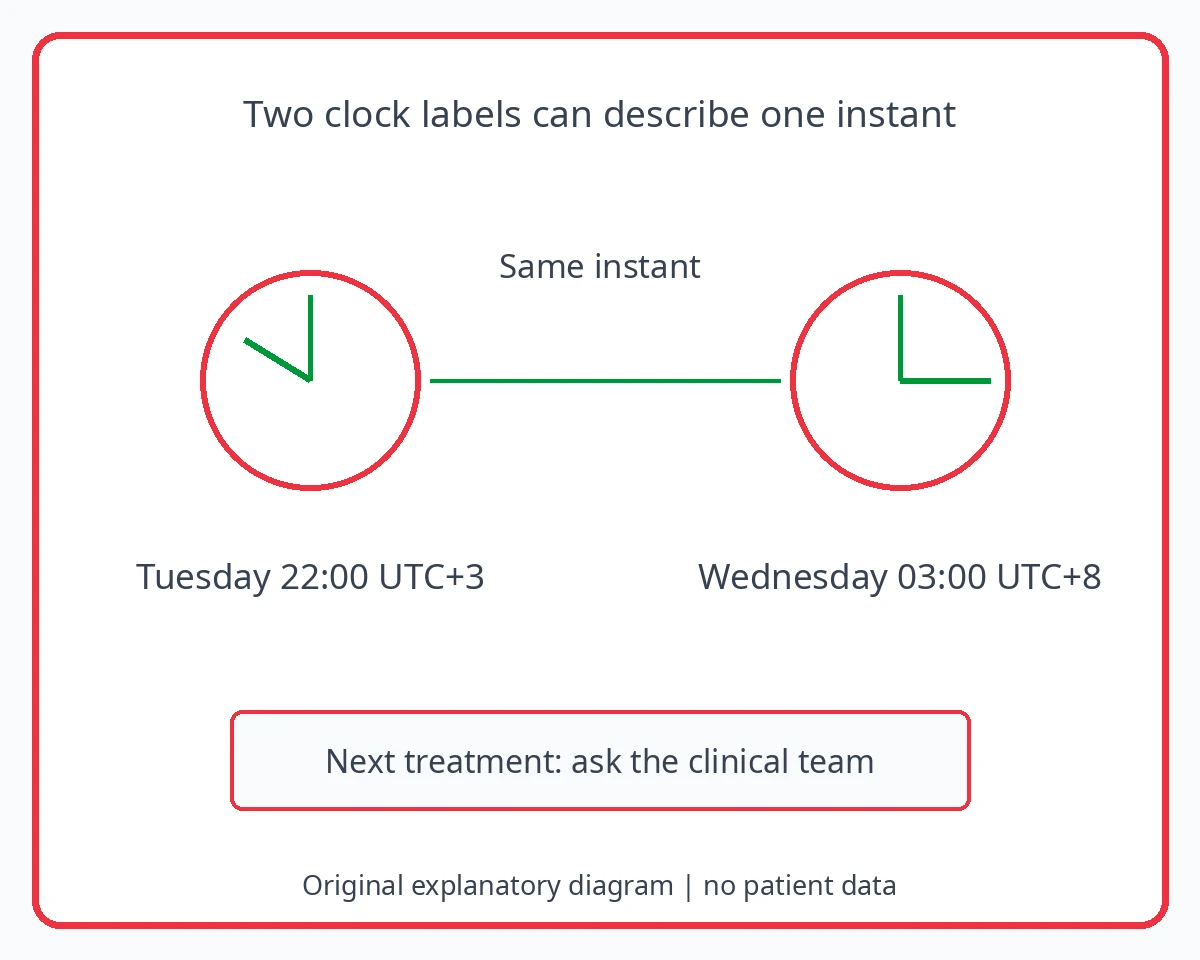
One instant can have two dates
In a fictional clock example, Tuesday 13 October 2026 at 22:00 in UTC+3 is Wednesday 14 October at 03:00 in UTC+8. UTC+8 is five hours ahead of UTC+3; adding those five hours crosses midnight. Both labels identify one instant.
Include the date and offset when recording the conversion. A time such as “03:00” without its date or zone is incomplete for this purpose. Use the actual itinerary’s offsets and check seasonal clock changes where relevant; the example does not assign either offset to your destination.
Bring the real schedule to the treatment team
CDC travel guidance supports advance planning for prescribed medicines. Bring the current clinician-provided instructions, local departure and arrival times, transit stops and likely disruptions. Ask the team to give clear instructions for the transition and what to do if the journey changes.
Do not turn the five-hour conversion in the example into an instruction to take treatment five hours earlier or later. Nor does an overnight flight establish that a dose has been missed. The clinical answer depends on the actual treatment and record, which a clock calculation does not assess. [1]
Two timestamps, one record identity
Fictional event E01 demonstrates timestamp recording only; no treatment time or dose is recommended.
| Record field | Entry | Meaning |
|---|---|---|
| Original label | E01: Tue 13 Oct 2026, 22:00 UTC+3 | One recorded instant |
| Converted label | E01: Wed 14 Oct 2026, 03:00 UTC+8 | Same instant, five hours added to the clock |
| Correct index | One E01 entry with its original and converted labels | No second event is created |
| Next treatment | No instruction supplied by this example | Obtain the actual plan from the clinical team |
Do not count the conversion as another administration
If E01 is copied onto two calendar dates without its shared identity, a later reader could mistake the entries for two administrations. Keep “converted display of E01” beside the second timestamp, or store one original event and show the local conversion as a view of it.
The absence of a second event does not answer when the next one should occur. That remains a separate clinical instruction. If the actual event time is uncertain, preserve the uncertainty instead of selecting a precise time merely to make the conversion easy.
Bring the complete itinerary to the planning discussion in Planning Travel With Prescribed Growth Hormone: Questions Before Departure
Read back the agreed plan in ordinary language
AHRQ encourages asking questions and making sure the care plan is understood. After the team explains the travel instructions, ask to confirm the date, local time or other timing information it wants you to use, and the contact route for a delay.
Keep that response beside the itinerary and the original record. A clock app can help display an instant in another zone, but it cannot decide whether an interval is medically appropriate. The useful record makes the distinction easy for you and for the next professional reading it. [2]
Keep any agreed record within the monitoring diary described in Keeping a Monitoring Diary During Prescribed Growth Hormone Treatment
Clock arithmetic does not set treatment intervals
No dosing interval, missed-dose instruction or time-zone treatment adjustment is given. The example is clock arithmetic only.
Sources and reading context
- CDC travel with restricted medications — Check destination and transit requirements; no country permission inferred
- AHRQ preparation for healthcare appointments — Organize concerns, questions and medicines for discussion