Planning Travel With Prescribed Growth Hormone: Questions Before Departure
A flight booking and a doctor’s letter can make a medicine travel plan feel nearly finished. The less visible parts often sit between the flight and the hotel: a transit stop, a long transfer, an unconfirmed storage arrangement or a question about entry documents. Put those parts on one route before deciding that the plan is ready.
Start with the supply you will actually carry
Bring the exact product name, presentation, current label and preparation status to the pharmacist. The US Genotropin label distinguishes presentations and conditions before and after preparation. It is a useful example of why “growth hormone in a cooler” does not identify the requirements for a particular supply.
Keep a copy or clear photograph of the relevant identity information with the travel file. If the supply changes before departure, return to the product-specific questions rather than assuming the earlier packing discussion still applies. A brand, device or preparation change can make an old summary the wrong starting point. [1]
When comparing product documents from different markets, read Why Growth Hormone Product Leaflets Can Differ Between Countries
For background on why formulations and devices require their own instructions, see HGHThai’s somatropin formulation guide
Split official requirements from storage arrangements
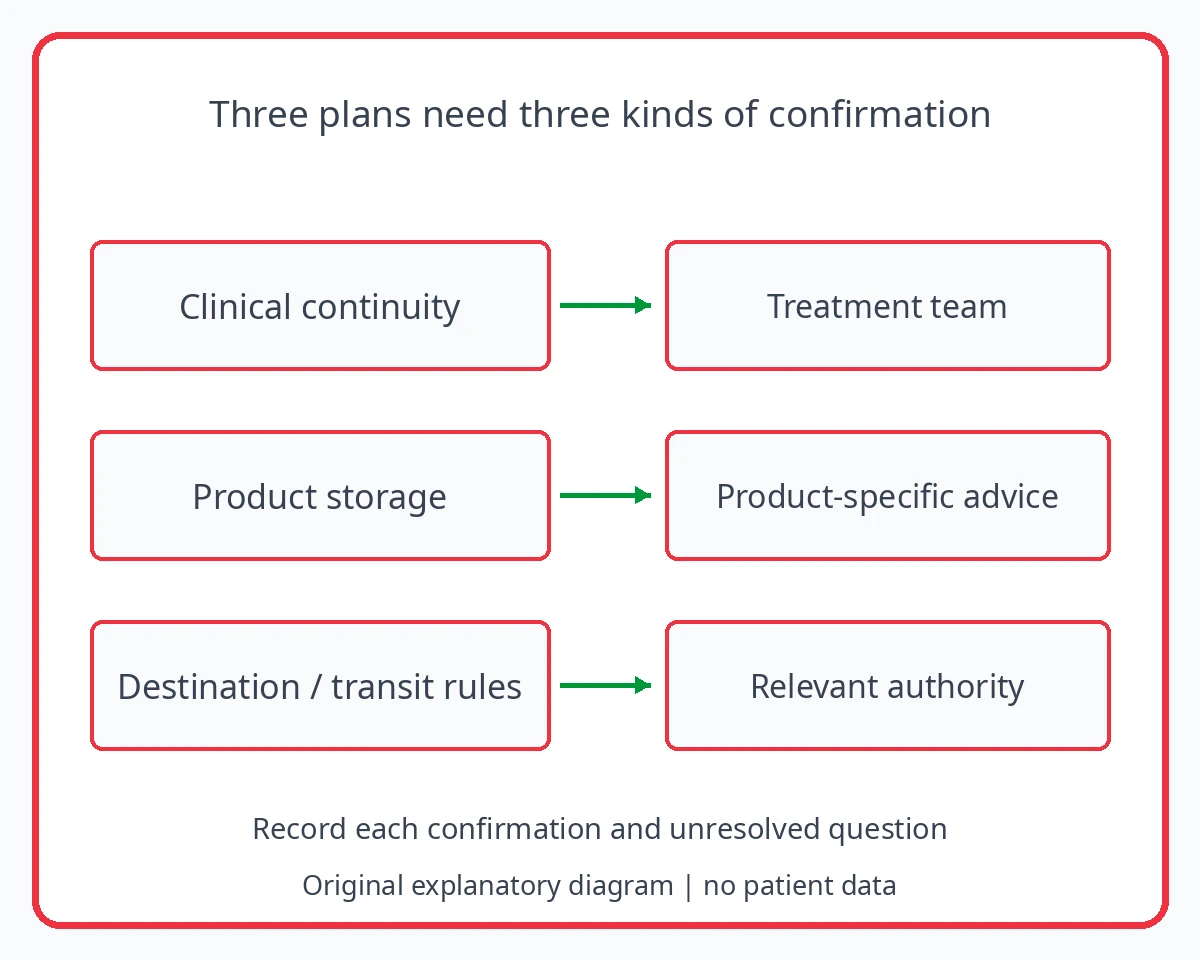
CDC travel guidance advises checking medicine restrictions for the destination and transit points. Record the actual route, including whether an overnight stop changes where you will stay or enter a country. Ask the relevant authorities about the exact medicine and circumstances, and the carrier about its own requirements.
For the UAE part of a journey, the Emirates Drug Establishment publishes a personal-medicine import service page with requirements, resources and support details. Use that current official route to clarify what applies to your product and travel status. The existence of the service does not establish the classification of your medicine or give you permission to carry it.
Hotel storage is a separate conversation. A room booking answers where you will sleep; it does not confirm the conditions in which the medicine will be kept. Send the product-specific requirements agreed with the pharmacist and ask what arrangement is actually available. [2] [3]
A route with unfinished tasks
Fictional planning record for a journey ending in Dubai. No carrier, hotel or official approval is represented.
| Planning question | Fictional record | What remains to do |
|---|---|---|
| Product | Current package and label saved; pharmacist discussion booked | Confirm the arrangement for this exact supply |
| Transit | An overnight stop was added after the original booking | Recheck the route and requirements for that stop |
| UAE documents | Clinical letter available; official product-specific question still unanswered | Use the current EDE guidance/support route |
| Arrival storage | Hotel confirms a minibar but gives no monitoring details | Clarify actual conditions with the hotel and pharmacist |
| Care continuity | Clinic contact saved; delay instructions not yet agreed | Ask the treatment team for the clinical contingency |
One completed document does not close the whole route
In the fictional record, the clinical letter is ready. The added overnight stop and the hotel arrangement are still open questions. A useful update is: “The letter is complete; the route and storage plan still need confirmation.” That tells everyone what has progressed without hiding the remaining work.
If the itinerary changes again, update the affected stages and keep the previous response dates visible. A confirmation about the original route should not quietly become confirmation about a different journey.
For the separate role of a travel letter, see What to Ask Your Clinic About a Travel Letter for Prescribed Medicine
Ask the treatment team for a usable contingency
Discuss the existing treatment instructions across time zones, delays and any gap between services. Ask who to contact if the plan cannot be followed, what information to provide and how to reach the team outside the usual appointment. These are clinical questions; a travel agent or hotel cannot settle them.
Keep the final answers by responsibility: clinical instructions from the treatment team, product handling advice from the appropriate professional, and administrative requirements from the relevant authority or carrier. The plan becomes useful when each answer has a source, a date and a clear connection to the journey. It does not create a replacement dose or guarantee supply abroad.
When discussing a time-zone change, record travel times with their UTC offsets so the same event is not mistaken for two different events.
Confirm the exact product, route and clinical plan
No country-specific import permission, treatment schedule or product storage limit is supplied. Confirm the current requirements for the exact route and medicine.
Sources and reading context
- Pfizer Genotropin prescribing information — Exact product label; do not transfer storage, dose or warnings to every GH product
- CDC travel with restricted medications — Check destination and transit requirements; no country permission inferred
- Emirates Drug Establishment: personal medicine import service — Current official UAE service landing page and support route inspected. Article identifies where to check exact product/traveller requirements; does not classify somatropin, decide eligibility, reproduce quantity allowances or issue permission. Legacy MOHAP pages inaccessible in this check.