Preparing for a Power Outage When Medicine Needs Refrigeration
A five-hour power cut does not prove five hours at one temperature. It describes the electricity supply. When a medicine has been in the refrigerator during an outage, keep the power timeline and temperature evidence side by side so neither is mistaken for the other.
Prepare the information you would need in an interruption
Keep the current product label, presentation details and pharmacist contact available. FDA disaster guidance supports medication-specific advice during disruptions. Discuss a contingency in advance instead of borrowing an emergency exception written for a different medicine.
Know where the monitoring record is stored and who can retrieve it. If several people share responsibility, agree who records an interruption and contacts the appropriate professional. A written plan is especially useful when the person who first notices the outage is not the person who manages the medicine. [1]
For questions about temporary refrigerator arrangements, read Using a Hotel Refrigerator for Prescribed Medicine: Checks to Discuss
Keep separate clocks for power and measurement events
Record the known outage start and restoration times, then add sensor readings with their own timestamps. SPS guidance emphasises the event history and monitoring information needed for assessment. Door openings or transfers belong in the history when known; they should not be invented to make a gap look complete.
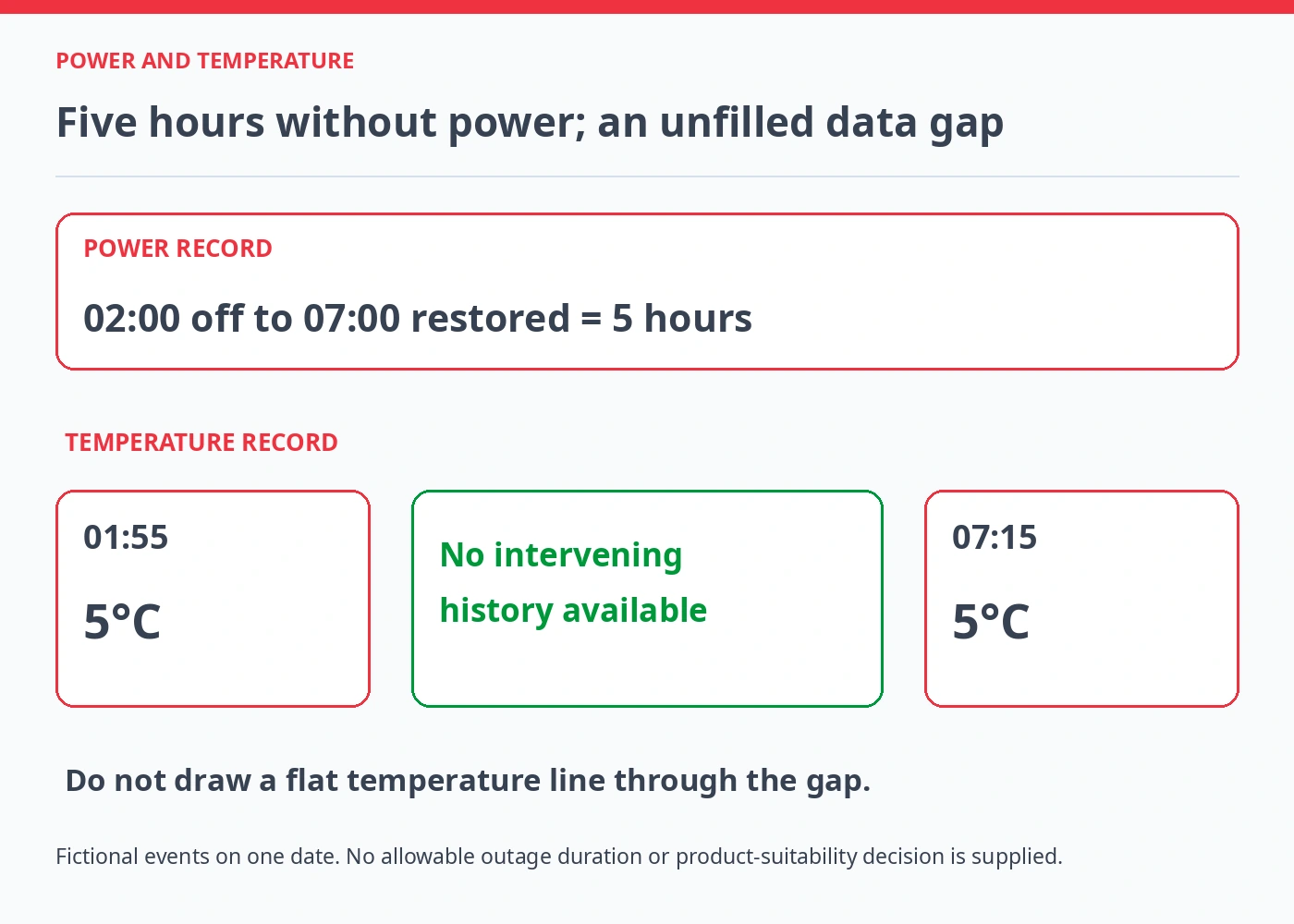
The fictional example has a five-hour power interruption, but only a reading before it and a reading after power returned. The two equal values do not establish that the intervening temperature was constant. The missing interval is part of the evidence the professional needs to understand. [2] [3]
Five hours without power, with a gap in temperature data
Fictional events on one date. Temperatures are illustrative readings, not approved product limits.
| Time | Known event | What remains unknown |
|---|---|---|
| 01:55 | Sensor reading recorded: 5°C | One measurement before the outage |
| 02:00 | Power interruption starts, according to the event record | No temperature reading at that instant |
| 02:00–07:00 | Power remains off; no logger history available | Medicine temperature during this interval is unknown |
| 07:00 | Power restored | Not a product-suitability decision |
| 07:15 | Sensor reading recorded: 5°C | One later measurement; does not fill the gap |
Do not replace a gap with a straight line
07:00 minus 02:00 is five hours of recorded power interruption. Drawing a flat 5°C line from 01:55 to 07:15 would add temperature information that the record does not contain. A better note is: “Power was off for five hours; these are the two readings available, with no intervening temperature history.”
If a logger file later becomes available, add it and identify its sensor location and covered period. Keep the original event record so the new information can be matched to the same interruption.
Use the exposure worksheet in A Growth Hormone Temperature Excursion: What Information Your Pharmacist Needs
Restored power does not close the product assessment
Preserve the event record and obtain product-specific advice before using the questioned supply. Keep it identifiable and separate from unaffected stock while the appropriate professional advises on handling. A later ordinary reading cannot establish that no relevant excursion occurred.
Do not improvise an unverified transfer into direct contact with ice simply to make a display colder. Ask about the actual product and available arrangement, and contact the treatment team about any effect on care. Document the response rather than independently changing the treatment schedule. [2] [4]
When saving the outage report, link the event to the correct medicine supply, keeping the original observations and later professional advice as separate entries.
Power duration is not a product storage allowance
No generic number of safe outage hours is provided. This article cannot determine potency, replacement needs or a treatment adjustment.
Sources and reading context
- FDA safe drug use after a natural disaster — Contingency planning only; generic reconstitution statements must not replace exact GH label
- SPS managing medicine temperature excursions — Professional principles: record exposure/product/time and obtain assessment. No home potency clearance or generic ambient allowance
- SPS medicine storage-temperature monitoring — Current/min/max versus time history; professional framework, not product release decision
- SPS transport temperature control — Transport performance depends on validated conditions; no vaccine timing extrapolation