A Growth Hormone Temperature Excursion: What Information Your Pharmacist Needs
Two records can show the same maximum temperature and tell very different stories. One may contain a short sequence of readings; another may have only a current display and a maximum since an unknown reset. After a possible medicine-storage problem, preserve that difference so the pharmacist can assess what the evidence actually shows.
A maximum is a value, not a duration
SPS guidance distinguishes a current reading, a minimum/maximum recorder and a time history from a logger. A maximum identifies the highest recorded value within the recorder’s period. On its own, it does not tell you when that value occurred or how long the conditions lasted.
Save the device identity, sensor location, timestamps and the period covered. If you do not know when a minimum/maximum display was reset, record that uncertainty. Two readings taken several hours apart do not fill the interval between them; a later reassuring-looking number cannot recreate missing data. [2] [1]
For an outage record that preserves the time gap, use Preparing for a Power Outage When Medicine Needs Refrigeration
Keep the product record alongside the event
Identify the exact medicine, presentation, batch where available and preparation status. The Genotropin label illustrates why conditions depend on the named presentation and state; another product’s allowance cannot be borrowed for yours.
Include earlier known storage events with the current one. If a supply moved between two bags or storage locations, show when the transfer happened and which record belongs to each location. Otherwise a complete-looking logger file may cover only part of the supply’s journey. [3] [1]
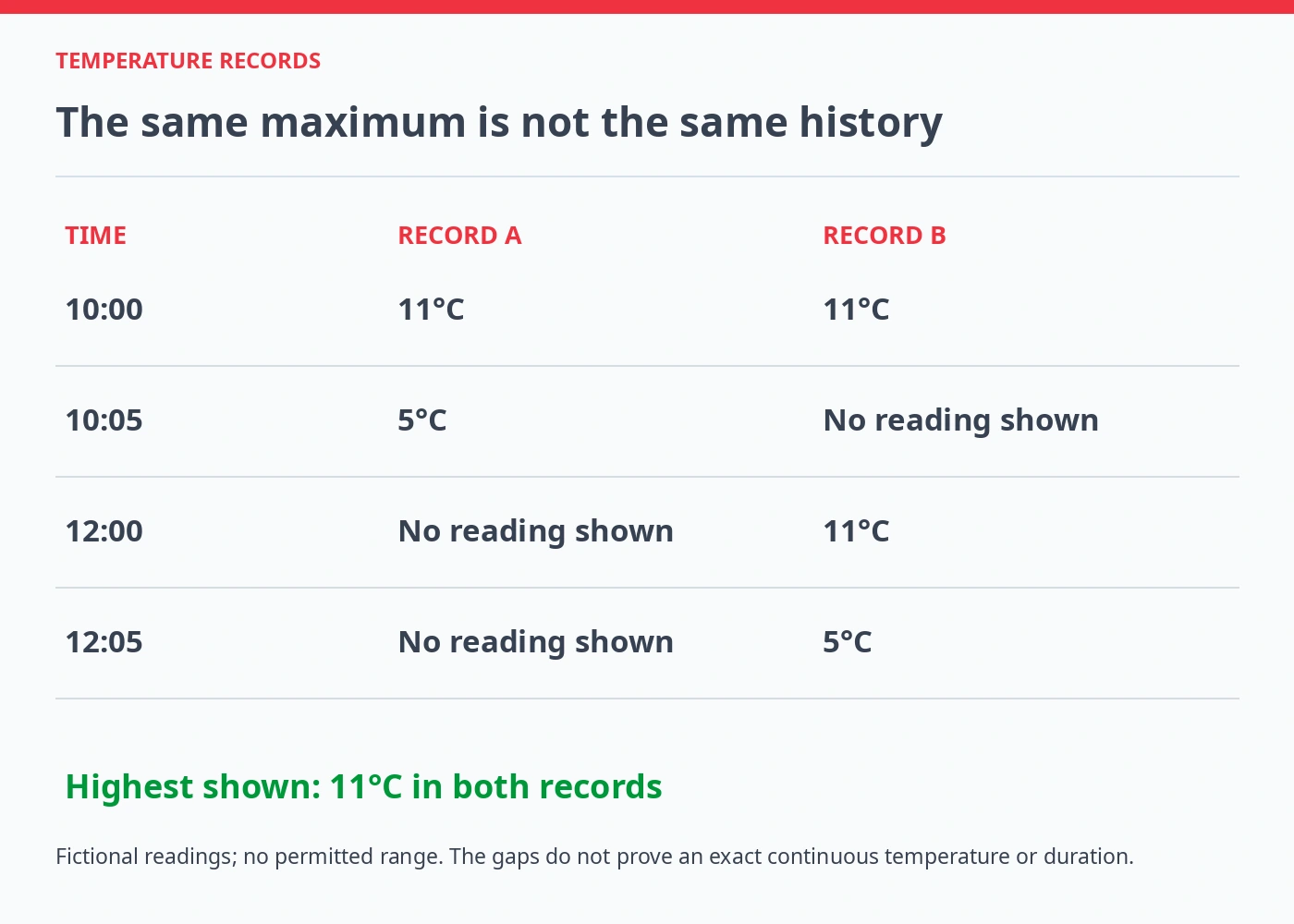
The same maximum, different recorded histories
Invented readings illustrate information quality only. Neither 5°C nor 11°C is a suitability decision or a permitted range for an unidentified medicine.
| Time | Fictional record A | Fictional record B |
|---|---|---|
| 10:00 | Record A: 11°C | Record B: 11°C |
| 10:05 | Record A: 5°C | Record B: no reading shown here |
| 12:00 | Record A: no reading shown here | Record B: 11°C |
| 12:05 | Record A: no reading shown here | Record B: 5°C |
| Highest value shown | 11°C | 11°C |
Report the readings without inventing the missing interval
Both invented records have a highest displayed value of 11°C. Record B also contains an 11°C reading two hours after its first one. That is additional evidence which the single maximum cannot communicate. It still does not prove that the temperature stayed exactly at 11°C throughout those two hours.
Send the original time history if it exists, rather than replacing it with “maximum 11”. If the only evidence is a display reading 5°C now and maximum 11°C, say that plainly and record the known reset time—or that it is unknown. Do not choose whichever account seems most favourable.
Keep product dates and preparation records distinct using Batch Numbers and Expiry Dates: What They Tell You About a Medicine
For the product distinctions behind those storage questions, read HGHThai’s guide to comparing somatropin presentations
Keep the affected supply identifiable while obtaining advice
Preserve the logger file, packaging details and event description, with unknown periods clearly marked. Keep the questioned supply identifiable and separate from unaffected stock, and obtain product-specific advice before using it. Ask the pharmacist or responsible team how to handle it during the assessment.
A return to ordinary storage or an unchanged appearance is not a decision about potency or suitability. Contact the treatment team about any effect on the care plan rather than independently changing the schedule. Record the advice actually received, who supplied it and the product or event it addressed. [1]
If the same journey also damaged the pack, describe packaging and device condition separately alongside the exposure record, without using appearance to decide suitability.
A record supports assessment; it does not release the medicine
The illustrative temperatures are not a permitted range. This guide cannot release an affected medicine for use or determine whether it must be replaced.
Sources and reading context
- SPS managing medicine temperature excursions — Professional principles: record exposure/product/time and obtain assessment. No home potency clearance or generic ambient allowance
- SPS medicine storage-temperature monitoring — Current/min/max versus time history; professional framework, not product release decision
- Pfizer Genotropin prescribing information — Exact product label; do not transfer storage, dose or warnings to every GH product