What to Ask Your Clinic About a Travel Letter for Prescribed Medicine
A useful travel letter connects the prescribed medicine with the person carrying it and explains relevant supplies. It should agree with the current prescription and package. It is still one document in the journey: entry requirements, carrier arrangements and clinical instructions each need their own source.
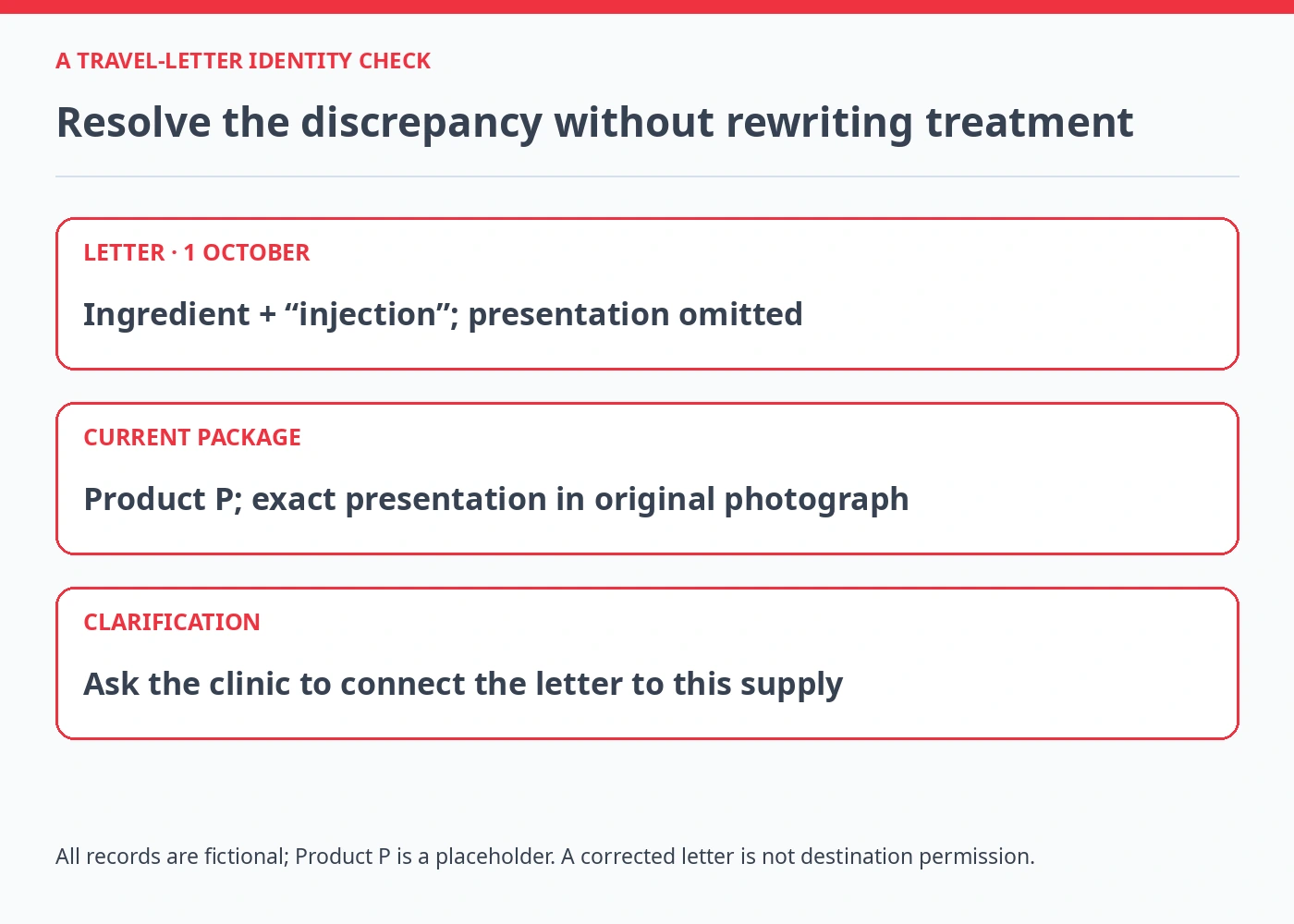
Ask the clinic to describe the actual prescribed supply
CDC travel guidance discusses prescription documentation and checking medicine restrictions. Ask the clinic to identify the medicine and associated devices or supplies as appropriate to the real prescription. Treatment instructions should come from the clinician’s current record, not from a travel template completed by guessing.
A generic ingredient name and a brand name can appear in different documents without automatically meaning two different medicines. The useful task is to make the relationship clear, including the presentation where relevant. An unexplained mismatch should go back to the clinic or pharmacist for clarification. [1]
Read the documents across, not one at a time
Use the prescription, current medicine list, letter and package identity together. FDA medicine-list guidance supports maintaining a current record. Check that an older letter has not silently become the description of a newer supply, and keep dates readable.
If translation is needed, ask what format the recipient requires. Retain the original and identify the translation’s status. Do not replace a brand or device name with a locally familiar product because it seems similar, or add a dose that is absent from the clinician’s record. [2]
If the journey also moves your care to another clinic, prepare a separate clinical-records transfer; the travel letter does not replace laboratory reports or imaging files.
An identity check that still leaves a clarification task
Fictional documents illustrate a discrepancy. “Product P” is a placeholder, not a marketed medicine or a prescription.
| Document | What the example contains | What the reader checks |
|---|---|---|
| Clinic letter, 1 October | Lists the ingredient and “injection”; presentation omitted | Ask the clinic to clarify the actual supply and relevant device |
| Current package record | Product P, presentation recorded in the original photograph | Retain the exact package identity with the query |
| Medicine list | Current use recorded; earlier product kept in the history section | Check the letter refers to current rather than past supply |
| Requirements record | Official route-specific requirements not yet confirmed | Do not mark this complete because the letter was issued |
A clarification request without rewriting the prescription
“The letter names the ingredient but does not identify the presentation shown in my current package photograph. Could you confirm the relationship and whether the related supplies need to be described?” This fictional request gives the clinic a concrete discrepancy to resolve.
Once clarified, retain the updated document with its date. The correction resolves the identity question it addresses; it does not establish import permission, a replacement supply overseas or a change to treatment.
For reading product identity from the package, see Growth Hormone Brand Names and Generic Names: Reading the Label
Use the official route for the permission question
For UAE travel, the Emirates Drug Establishment’s personal-medicine service page provides an official starting point for requirements and support. Check the exact product and your travel circumstances there; a clinician’s letter and an administrative approval perform different roles.
Check other destination or transit requirements and the carrier’s rules separately. Record the source and date of each response, along with any additional document still needed. Avoid treating a general template or a previous traveller’s successful journey as confirmation for your own supply. [3] [1]
Keep the letter within the wider travel plan in Planning Travel With Prescribed Growth Hormone: Questions Before Departure
A letter and official permission serve different purposes
No official letter template or country-specific permission is supplied. Only the responsible clinician and relevant authorities can confirm their respective requirements.
Sources and reading context
- CDC travel with restricted medications — Check destination and transit requirements; no country permission inferred
- FDA medication-list guidance — Organization of existing prescribed instructions, OTC products and supplements; not prescribing advice
- Emirates Drug Establishment: personal medicine import service — Current official UAE service landing page and support route inspected. Article identifies where to check exact product/traveller requirements; does not classify somatropin, decide eligibility, reproduce quantity allowances or issue permission. Legacy MOHAP pages inaccessible in this check.