Moving Between Countries: Organizing Endocrine Care Records
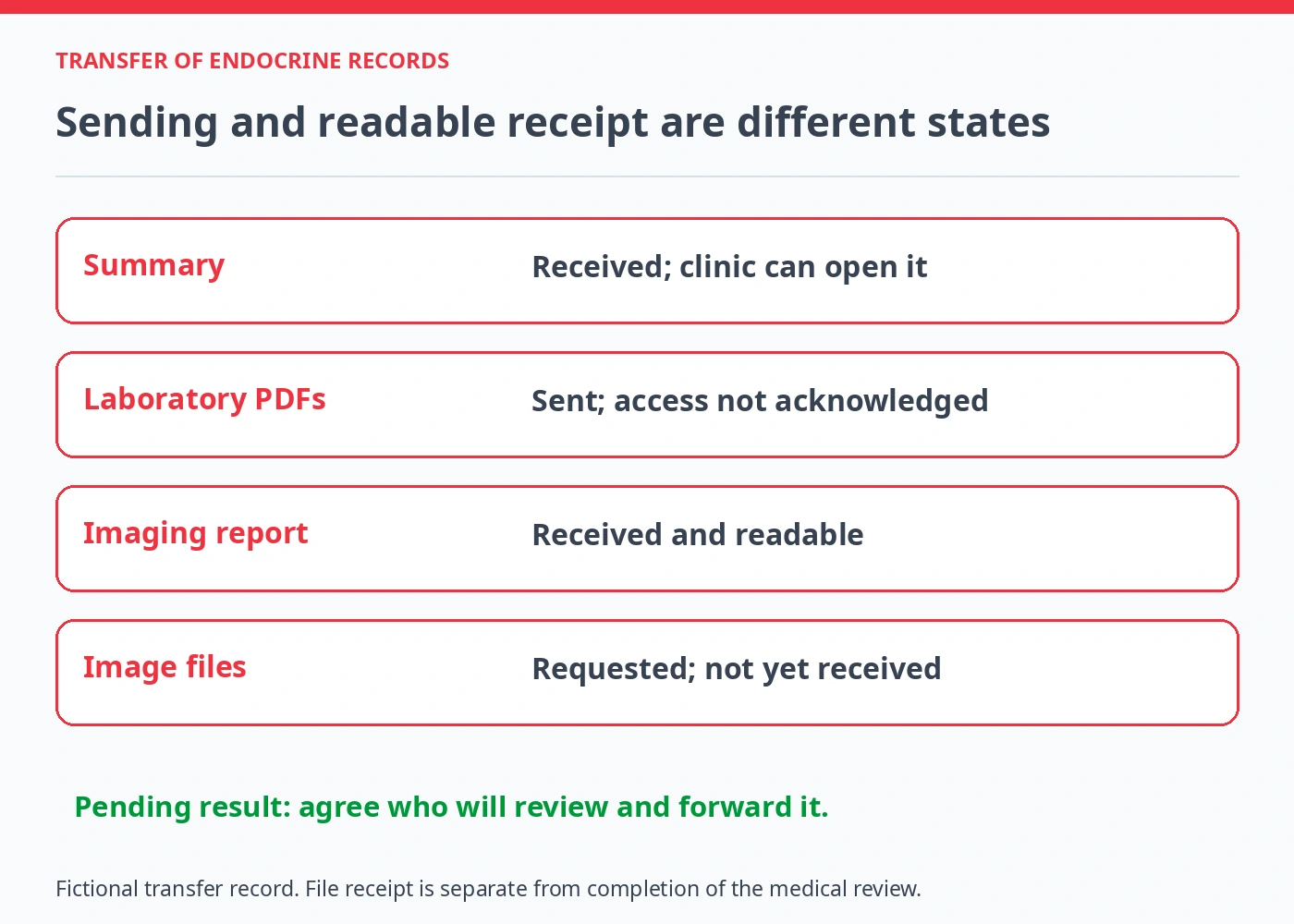
“The records were sent” can mean a summary, a laboratory PDF or an imaging report. It may not mean the image files arrived, or that the receiving team can open them. When moving endocrine care between countries, name the record types separately and track usable receipt as well as sending.
A summary and original records answer different needs
Samitivej describes provider-specific arrangements for medical records and imaging files. Bangkok Hospital Phuket separately discusses a medical summary and copies of results. These examples show why asking for “all my records” may need a more precise follow-up; they do not establish worldwide formats, fees or turnaround times.
List consultation summaries, original laboratory reports, imaging reports and image files with their dates and availability. Preserve laboratory units and reference information. A translated summary can help the next team navigate the history, but it should not silently replace the original report or be presented as a certified translation when it is not. [1] [4]
For provider-specific record-transfer questions in Thailand, see Transferring Endocrine Medical Records to a Thai Care Team
For a concise index of the original records, use Organizing Laboratory Results for a Pituitary Appointment
Separate current treatment from past or proposed treatment
FDA medicine-list guidance supports a current, identifiable record. Keep the actual product and clinician-provided instructions with their source and date. Mark earlier therapy as historical and a proposed change as proposed; putting them all in one undated list can make the record ambiguous.
If the receiving service needs clarification, ask the responsible team to resolve the discrepancy. Do not rewrite a foreign product into a different local brand or assume that a translated letter establishes eligibility for prescribing in the new country. Identification and local clinical review are separate tasks. [2]
A packet that is partly usable and partly pending
Fictional transfer from a previous service to a receiving endocrine clinic. No real service response is represented.
| Record type | Current status | Next action |
|---|---|---|
| Consultation summary | PDF received; clinic confirms it can open the file | Retain the acknowledged version |
| Laboratory reports | Original PDFs sent; access not yet acknowledged | Ask the clinic to confirm readable receipt |
| Imaging report | Written report received and readable | Keep it separate from the image-file status |
| Image files | Requested from the previous service; not yet received | Follow up the request through the agreed route |
| Pending result | Earlier service still expects one report | Confirm who will review and forward it |
“Imaging complete” would hide an unfinished task
The fictional clinic has the written imaging report, but the image files are still being requested. Those are two statuses. A useful message says: “The report is readable; the image files are pending from the previous service.” That allows the receiving team to decide what it needs before the appointment.
The laboratory PDFs have also been sent without an access acknowledgment. Keep the sending confirmation, but do not treat it as proof that the files are usable. A brief reply confirming readable receipt closes a different question from whether the medical review has happened.
Agree who owns the gap between services
Ask the receiving clinic about accepted formats, languages, referral information and a secure transfer route. CDC travel guidance supports planning medication needs in advance, but a packet of records alone does not guarantee that a prescription will continue in another country.
Identify who will review results that arrive during the transition and how you will receive the explanation. Keep the contact and agreed next step with the packet. This prevents a document from being successfully transferred while the responsibility for acting on it remains unclear. [3]
For the broader reasons endocrine follow-up considers the whole care picture, see HGHThai’s discussion of coordinated follow-up
If the same move involves travel, prepare a separate medicine travel letter; it serves a different purpose from the clinical records being transferred.
The receiving service must confirm its requirements
No service availability, prescription transfer, import permission or translation certification is guaranteed. Confirm those matters with the receiving service and relevant authorities.
Sources and reading context
- Samitivej medical records — Provider-specific records process; no universal fee, timing or consent rule
- FDA medication-list guidance — Organization of existing prescribed instructions, OTC products and supplements; not prescribing advice
- CDC travel with restricted medications — Check destination and transit requirements; no country permission inferred
- Bangkok Hospital Phuket international patient services — Provider-specific guarantee-of-payment limits and aftercare records; no general endocrine insurance coverage